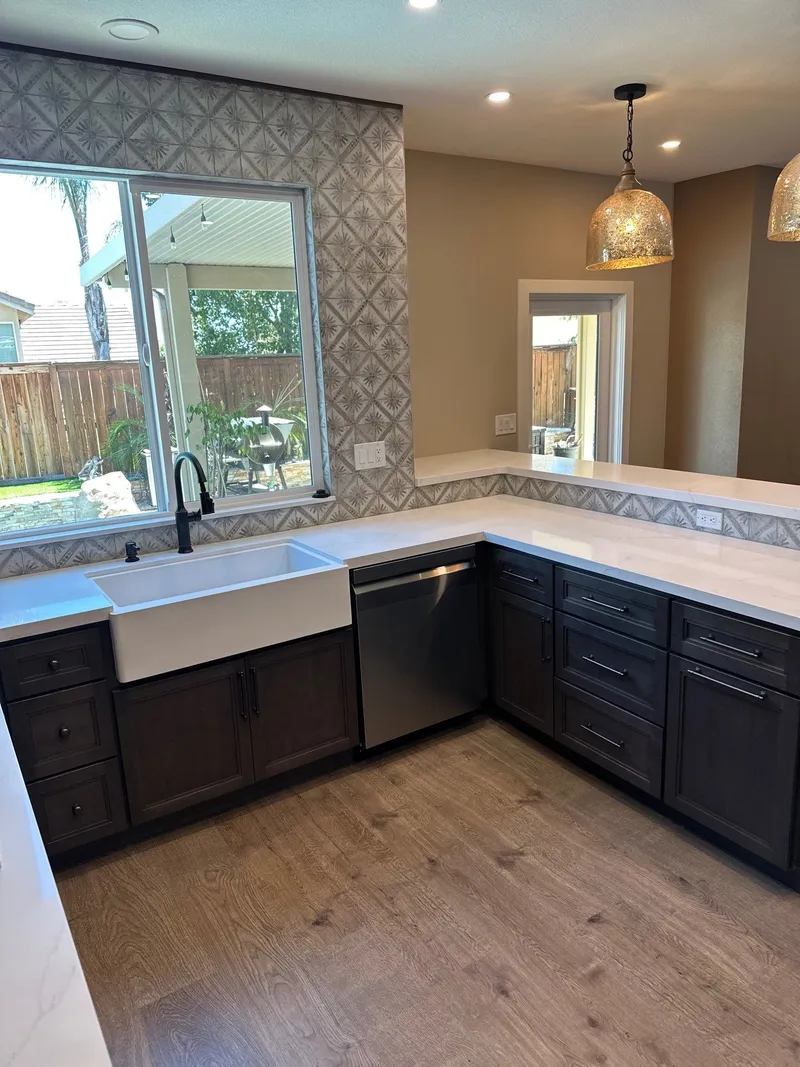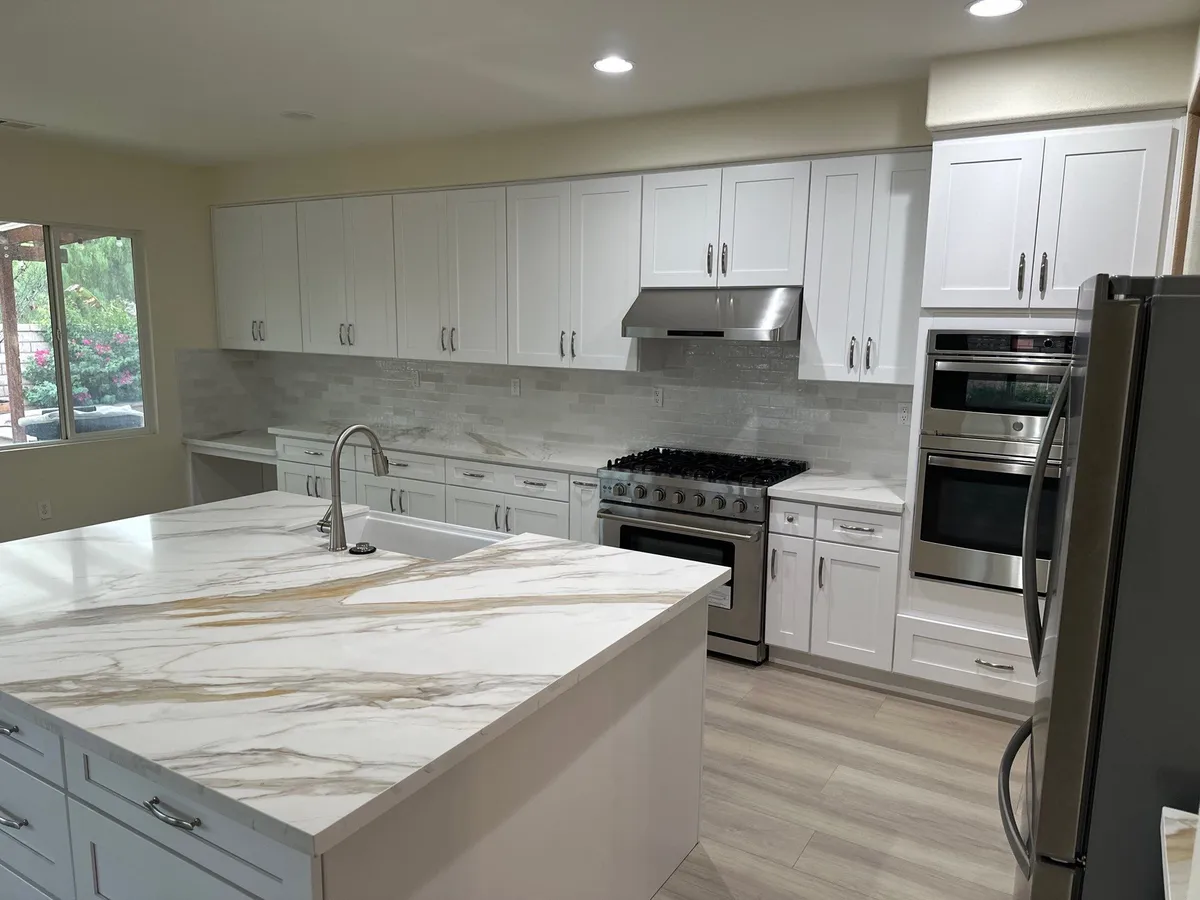

Key Takeaways
- Heirloom-quality cabinets last 50+ years when built with solid hardwoods and furniture-grade plywood, while standard cabinets need replacement every 10-15 years.
- Investing in premium cabinetry saves money long-term by eliminating repeated replacement and repair costs that budget options require.
What Most People Get Wrong About Heirloom-Quality Cabinets
Most homeowners think price equals quality in cabinetry, but after building custom cabinets across Murrieta for over a decade, I’ve learned that’s rarely true. The biggest mistake I see is assuming a lower price point gives you similar durability—it doesn’t. Budget cabinets use particle board and thin veneers that warp and chip within 5-7 years, especially in Murrieta’s summer heat and humidity swings.
I’ve walked into dozens of homes in Bear Creek and Greer Ranch where homeowners chose box-store cabinets to save money, only to call us for replacements within 8 years. The particle board cores swell when moisture seeps in, the veneer peels at the corners, and the hinges strip out because there’s no solid wood to hold the screws. One client showed me cabinets installed in 2015 that looked 20 years old—the doors wouldn’t close, and the finish had bubbled near the dishwasher.
At First Class WoodWorks, we build exclusively with solid hardwoods—red oak, maple, cherry—and 3/4-inch furniture-grade plywood with no particle board filler. Every cabinet box gets Blum Tandem soft-close drawer slides rated for 110 pounds and backed by Blum’s lifetime warranty. The drawer boxes themselves feature 5/8-inch Baltic birch with dovetail joints, not stapled particleboard. I’ve installed cabinets this way for 12 years, and I’ve never had one come back for structural failure.
The upfront cost runs higher, but you’re buying once instead of twice. A typical kitchen with our custom kitchen cabinets costs $18,000-$35,000, while budget cabinets run $8,000-$12,000. But when you replace those budget cabinets in 10 years—and pay for demo, disposal, and installation again—you’ve spent $16,000-$24,000 total and still don’t have the quality you could’ve had from the start.
What Are the Key Features of Heirloom-Quality Cabinets?
Heirloom-quality cabinets feature solid hardwood face frames, furniture-grade plywood boxes, dovetail drawer construction, and premium soft-close hardware with lifetime warranties. These materials and techniques ensure cabinets last 50+ years while maintaining structural integrity and aesthetic appeal through decades of daily use.
The difference between heirloom and standard cabinets comes down to materials and joinery. We use solid red oak, maple, or cherry for face frames and doors—never MDF or particle board cores with veneer. Cabinet boxes get 3/4-inch furniture-grade plywood with hardwood-veneer interiors that won’t delaminate when humidity changes. Standard cabinets use 1/2-inch particleboard or thin plywood that warps.
Drawer construction separates good cabinets from great ones. Our drawer boxes use 5/8-inch Baltic birch plywood joined with English dovetails—eight interlocking joints per corner that distribute stress and prevent separation. We’ve never had a dovetailed drawer fail. Budget cabinets use stapled particleboard that pulls apart within 3-5 years of normal use. Every drawer rides on Blum Tandem undermount slides rated for 110 pounds with lifetime warranties, not the 75-pound side-mount slides that break after 2-3 years.
We build to 1/16-inch tolerances using Festool track saws and Blum 32mm drilling jigs. This precision means doors align perfectly, reveals stay consistent, and nothing binds or rubs. Here’s what you get with our construction:
| Feature | Our Standard | Why It Matters |
|---|---|---|
| Box Material | 3/4” furniture-grade plywood | Resists warping, holds screws 3x better than particleboard |
| Drawer Boxes | 5/8” Baltic birch, dovetail joints | Supports 110 lbs, lasts 50+ years vs. 5-7 for stapled boxes |
| Drawer Slides | Blum Tandem undermount, 110 lb capacity | Lifetime warranty, smooth operation for decades |
| Hinges | Blum Clip Top soft-close, 6-way adjustable | Lifetime warranty, prevents door sag over time |
| Face Frames | Solid hardwood, mortise-and-tenon joints | Won’t separate or crack like pocket-screw construction |
| Finish | Catalyzed conversion varnish, 5-coat process | Commercial-grade durability, resists moisture and scratches |
We also apply catalyzed conversion varnish—the same finish used in restaurants and hotels—not the pre-catalyzed lacquer that chips and yellows. Five coats with sanding between each creates a finish that handles daily wear for 30+ years. If you’re planning a full kitchen update, our kitchen remodeling in Murrieta service includes cabinet design, countertops, and installation.
How Do Heirloom-Quality Cabinets Compare in Cost?
Heirloom-quality cabinets cost $650-$1,200 per linear foot in Murrieta, compared to $150-$350 for standard cabinets. This 3-4x price difference reflects solid hardwood construction, dovetail joinery, and premium hardware that delivers 50+ years of service versus 10-15 years for budget options, making the per-year cost nearly identical.
I built a kitchen in Greer Ranch last year where the homeowner compared our bid against a big-box quote. Our cabinets came in at $28,500 for 24 linear feet, while the store quoted $9,800. That looks like a huge gap until you factor in longevity. Our cabinets will serve that family for 50+ years—that’s $570 per year. The box-store cabinets need replacement in 12-15 years at best, which means two replacement cycles over 50 years at $9,800 each, plus inflation. That’s $22,000-$26,000 total, or $440-$520 per year—and you still end up with inferior cabinets.
Here’s the real cost breakdown based on 24 linear feet of cabinets in a typical Murrieta kitchen:
| Option | Initial Cost | Lifespan | Replacement Cycles (50 years) | True 50-Year Cost | Annual Cost |
|---|---|---|---|---|---|
| Box-Store Cabinets | $8,000-$12,000 | 10-15 years | 3-4 times | $24,000-$48,000 | $480-$960 |
| Semi-Custom Stock | $15,000-$22,000 | 15-20 years | 2-3 times | $30,000-$66,000 | $600-$1,320 |
| First Class WoodWorks | $24,000-$38,000 | 50+ years | 0 times | $24,000-$38,000 | $480-$760 |
The comparison gets even better when you factor in Murrieta’s climate. Summer temperatures hit 95-100°F regularly, and humidity swings between 15% and 65% depending on the season. According to the Western Wood Products Association, particleboard swells up to 8% when exposed to humidity changes, while furniture-grade plywood with hardwood veneers swells less than 2%. That means box-store cabinets develop gaps, doors that won’t close, and drawer fronts that bind—problems I’ve repaired dozens of times in homes less than 8 years old.
We also see cost differences in hardware longevity. Blum Tandem slides carry a lifetime warranty and function perfectly after 25 years of daily use. Generic side-mount slides fail within 3-5 years and cost $180-$240 per kitchen to replace, including labor. Over 50 years, that’s $1,800-$4,800 in slide replacements alone for budget cabinets.
Our cabinet maker services include detailed cost breakdowns during your consultation, so you understand exactly what you’re paying for and why it matters.
What Is the Process for Ordering Heirloom-Quality Cabinets?
The process takes 7-11 weeks total: 1 week for consultation and measuring, 2-3 weeks for design and material selection, 4-6 weeks for fabrication, and 3-5 days for installation. We handle everything from initial measurements through final adjustment, ensuring your cabinets fit perfectly and function flawlessly from day one.
I start every project with an in-home consultation where I measure your space, discuss your cooking habits and storage needs, and assess any structural considerations. Murrieta homes built after 2005 typically have standard 8-foot ceilings and drywall over wood framing, but older homes in areas like La Cresta might have plaster walls or non-standard dimensions that affect cabinet design. I check for plumb walls, level floors, and any electrical or plumbing that needs relocation—details that prevent problems during installation.
After measuring, I create 3D renderings using Cabinet Vision software that shows exactly how your cabinets will look with different door styles, finishes, and hardware. We review 4-6 hardwood samples in your kitchen under natural light because wood looks completely different under your skylight than it does in our shop under LED work lights. I bring physical samples of Blum hardware so you can feel the difference between soft-close and standard hinges—most people choose soft-close once they test both.
Once you approve the design, I order materials from our suppliers—hardwood lumber from Pacific Hardwood & Veneer and plywood from CalForest Products. Fabrication takes 4-6 weeks because we’re building everything by hand in our Murrieta shop, not ordering pre-made boxes. I cut dovetails on our Leigh jig, drill hinge holes with Blum’s 32mm system for perfect alignment, and apply five coats of conversion varnish with 24 hours of cure time between coats.
Installation typically takes 3-5 days for a full kitchen. I start by shimming and leveling base cabinets, then mount uppers using 3-inch screws into studs—never drywall anchors that pull out over time. Doors and drawers get final adjustment to ensure consistent reveals and smooth operation. Every hinge on Blum hardware adjusts in six directions, so I can dial in perfect alignment even if your walls aren’t perfectly plumb.
At First Class WoodWorks, we coordinate with your countertop installer, plumber, and electrician to keep the project moving smoothly. If you’re planning a complete renovation, check out our custom cabinetry services Murrieta page to see everything we handle.
How Heirloom-Quality Cabinets Are Made
Heirloom cabinets are made by cutting solid hardwoods and furniture-grade plywood to precise dimensions, joining them with mortise-and-tenon or dovetail joints, and applying five coats of catalyzed conversion varnish. This traditional joinery combined with modern precision equipment creates cabinets that maintain structural integrity for 50+ years of daily use.
I build every cabinet in our shop at 24491 Avenida Arconte here in Murrieta, starting with material selection. Red oak comes from Appalachian forests and gets kiln-dried to 6-8% moisture content—critical for stability in Murrieta’s climate where indoor humidity swings from 30% in winter to 55% in summer. Maple and cherry get the same treatment. We only use quartersawn lumber for face frames because the grain orientation makes it 30% less prone to warping than flatsawn boards.
Cabinet boxes start as 3/4-inch furniture-grade plywood sheets that I cut on our Festool TS 75 track saw with a zero-clearance guide track for perfectly straight cuts. Every piece gets edge-banded with 2mm solid wood strips using Festool’s edge bander and trimmed flush with their MFT/3 table. Box joints are dados cut on our router table with spiral upcut bits—these create mechanical locks that distribute stress across 6-8 inches of glue surface, not just the 1/4-inch that pocket screws provide.
Drawer construction uses 5/8-inch Baltic birch plywood joined with English dovetails cut on our Leigh D4R Pro jig. Each corner gets eight interlocking pins and tails that physically lock the joint together. I’ve pulled apart old cabinets where the glue failed but the dovetails still held the drawer together—that’s engineering that works. Drawer bottoms get set into 1/4-inch grooves, not stapled on top like budget drawers.
Face frames use solid hardwood joined with mortise-and-tenon joints—1/2-inch-thick tenons that insert into mortises and get glued under pressure. These joints have held furniture together for 300+ years because they distribute stress perpendicular to the wood grain where it’s strongest. I cut mortises on our Festool Domino joiner and tenons on the table saw, then assemble frames with Bessey K-Body clamps applying 600 pounds of clamping pressure until the glue cures.
Finishing takes 8-10 days total. I sand to 220 grit, apply vinyl sealer, sand again at 320 grit, then spray three coats of catalyzed conversion varnish with 24 hours between coats. This creates a finish that’s chemically cured, not just dried—it won’t soften when exposed to heat or moisture like pre-catalyzed lacquer does. The final coat gets wet-sanded with 600-grit paper and buffed to a smooth satin finish.
Hardware installation uses Blum’s 32mm system—a drilling template that positions hinge holes with 0.5mm accuracy. This precision means all doors align perfectly with consistent 2mm reveals between doors and frames. I install Blum Clip Top hinges with integrated soft-close dampers and Tandem undermount drawer slides rated for 110 pounds. Every piece of hardware gets a lifetime warranty because Blum has been manufacturing cabinet hardware in Austria since 1952 and stands behind their engineering.
What Are the Cost Factors for Heirloom-Quality Cabinets?
Cabinet costs in Murrieta depend on four factors: material choice ($200-$600 per linear foot), design complexity ($100-$400 per linear foot), hardware quality ($50-$200 per door/drawer), and labor ($150-$400 per linear foot). A typical 10×12 kitchen with 22 linear feet of cabinets and a 6-foot island runs $24,000-$38,000 installed.
Material selection drives the biggest cost variance. Red oak runs $280-$350 per linear foot for materials because it’s abundant and machines easily. Maple costs $320-$420 per linear foot due to its denser grain structure that takes more time to sand and finish. Cherry and walnut hit $450-$600 per linear foot because they’re less common and require special finishing techniques to bring out the color depth.
Design complexity adds cost through additional labor and precision work. A simple shaker-style door with square edges takes 25-30 minutes to build and finish. A raised-panel door with beaded frames requires 55-70 minutes because the raised panel gets shaped on a router table in four passes, and the beading detail gets cut with a specialized bit. Glass doors add $85-$140 per door because I have to cut precise rabbets for the glass, drill holes for shelf pins, and install glass carefully to prevent cracking.
Hardware choices range from functional to premium. Blum Clip Top hinges with soft-close cost $12-$15 per hinge (you need 2-4 per door), while standard European hinges run $3-$5. Blum Tandem undermount drawer slides cost $45-$75 per set depending on length, compared to $8-$15 for basic side-mount slides. The difference shows up immediately—soft-close hardware prevents slamming that loosens joints over time, and undermount slides support 110 pounds versus 75 pounds for side-mount options.
| Cost Factor | Budget Range | Mid-Range | Premium | What You Get |
|---|