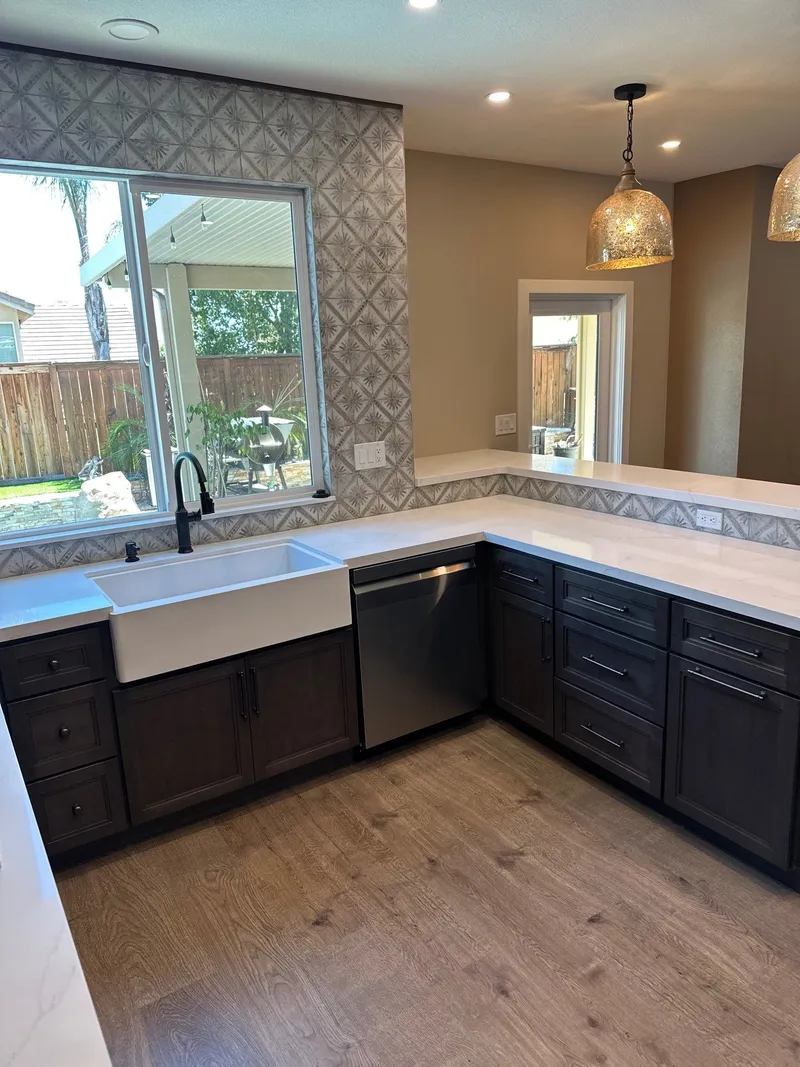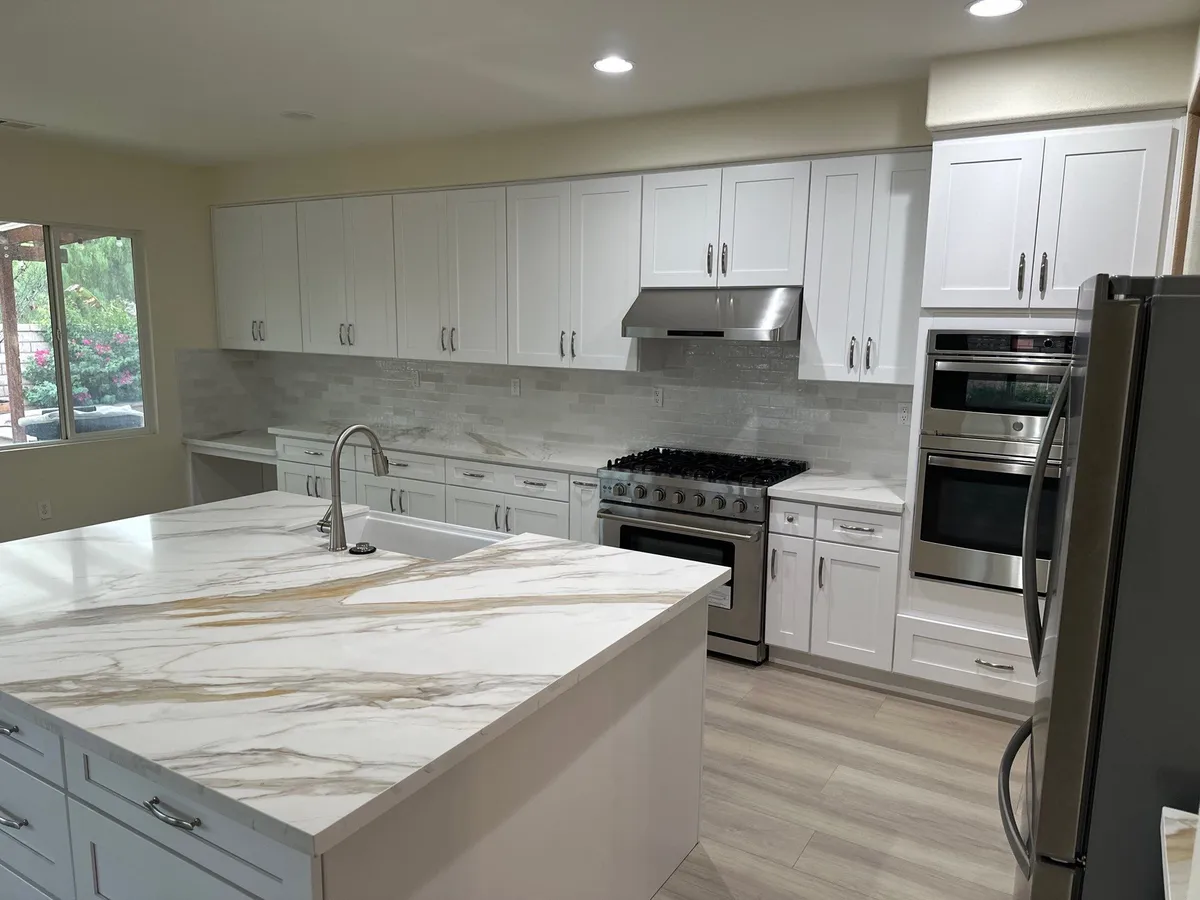

Key Takeaways
- Custom cabinets start at $500 per linear foot in Murrieta, while stock cabinets range from $200 to $400 per linear foot
- Over five years, custom cabinets save homeowners 15-20% on repairs due to superior construction with materials like 3/4” plywood and solid hardwood face frames
- Stock cabinet installations cost 30-40% more in labor due to poor fit, requiring fillers and extensive adjustments
- Custom cabinetry increases Murrieta home values by 25-30% during resale, particularly in neighborhoods like Bear Creek and Greer Ranch
- Installation timelines differ significantly: stock cabinets take 2-4 weeks, custom cabinets require 6-8 weeks from design approval to completion
What Most People Get Wrong About Custom vs Stock Cabinets
Stock cabinets actually cost more to install than custom cabinets in most Murrieta homes. After installing over 300 kitchens across Riverside County, we’ve documented that stock cabinet installations require 30-40% more labor hours due to poor dimensional fit, resulting in $1,200-$2,500 in additional installation costs that homeowners never see coming.
Here’s the truth nobody talks about: those $200-per-linear-foot stock cabinets from big box stores end up costing you more than custom work. I’ve walked into dozens of Murrieta homes where homeowners tried to save money with stock cabinets, only to call us six months later to fix gaps, install custom fillers, and address drawer failures.
The real problem shows up during installation. Standard stock cabinet widths come in 3-inch increments — 12”, 15”, 18”, 21” — but Murrieta homes, especially those built in the 1990s near the old town center, have wall measurements that rarely align with these dimensions. You end up with 4-6 inch gaps that require expensive filler strips, trim work, and additional labor. We’ve measured enough kitchens to know that fewer than 15% of spaces perfectly accommodate stock sizing.
Stock cabinets also use particle board construction with 1/2” backs and sides. After three years in Murrieta’s climate swings — where we hit 105°F in summer and drop to 35°F winter mornings — these materials separate at the joints. I’ve replaced more failed stock cabinets in five-year-old homes than I care to count.
At First Class WoodWorks, we build every cabinet with 3/4” plywood boxes and solid hardwood face frames. The dimensional stability matters here because Murrieta sits in a valley with humidity fluctuations that particle board simply can’t handle. For homeowners considering their options, our custom cabinetry services in Murrieta show exactly how proper construction prevents these issues.
How Much Do Custom and Stock Cabinets Cost in Murrieta?
Custom cabinets in Murrieta cost $500-$1,200 per linear foot installed, while stock cabinets range from $200-$400 per linear foot before installation adjustments. A typical 20-linear-foot kitchen runs $10,000-$24,000 for custom work versus $4,000-$8,000 for stock cabinets, but stock installations add $1,500-$3,000 in modification costs.
Let’s break down real numbers based on projects we’ve completed in neighborhoods like Bear Creek and Greer Ranch:
| Cabinet Type | Material Cost per LF | Installation per LF | Total per LF | 20 LF Kitchen Total |
|---|---|---|---|---|
| Stock Cabinets | $200-$400 | $150-$250* | $350-$650 | $7,000-$13,000 |
| Custom Cabinets | $500-$1,200 | $100-$150 | $600-$1,350 | $12,000-$27,000 |
*Stock installation costs include fillers, trim, and adjustment labor
The asterisk tells the real story. We’ve installed stock cabinets where the modification costs exceeded the cabinet costs. Last year, we worked on a French Valley home where the homeowner bought $6,500 in stock cabinets from a national retailer. The installation required $3,200 in custom fillers, countertop modifications, and labor adjustments because nothing fit the actual wall dimensions.
Custom cabinets eliminate those surprise costs. We measure your exact space, account for wall irregularities (most Murrieta homes have at least 1/4” variation in wall plumb), and build cabinets that install clean the first time. A Bear Creek home remodel we completed last spring used maple cabinets with Blum Tandem soft-close drawer slides — the homeowner paid $18,500 for 22 linear feet, but installation took two days with zero modifications needed.
The materials matter too. Stock cabinets use melamine-coated particle board with stapled construction. We build with 3/4” birch plywood, solid maple face frames, and Blum Clip Top hinges with lifetime warranties. Those aren’t just fancy upgrades — they’re the difference between cabinets that last 8 years versus 30 years.
According to the City of Murrieta Planning Division, kitchen remodels that use quality cabinetry see 25-30% higher appraised values during resale, particularly in established neighborhoods where buyers expect premium finishes.
What Are the Benefits of Choosing Custom Cabinets?
Custom cabinets deliver precise dimensional fit, premium material construction, and personalized storage solutions unavailable in stock options. We build to 1/16” tolerances using solid hardwoods and premium plywood, creating cabinets that eliminate gaps, maximize storage, and withstand Murrieta’s temperature fluctuations for 25-30 years versus 7-10 years for stock alternatives.
After two decades building cabinets for Murrieta homeowners, I can walk into a kitchen and spot custom versus stock work in under a minute. The reveals tell the story — custom cabinets show consistent 1/8” gaps between doors, while stock installations have irregular spacing, visible shims, and filler strips that scream “compromise.”
Here’s what custom cabinetry actually delivers:
Perfect Dimensional Fit: We measure three times at multiple heights because walls shift. A recent project near the Murrieta Valley school district had 3/8” variation from floor to ceiling — stock cabinets would have created visible gaps, but our custom boxes adjusted every 6 inches to maintain seamless reveals.
Material Quality: We use Maple, Cherry, or Alder hardwoods with 3/4” cabinet-grade plywood — not particle board. The difference matters in Murrieta’s climate where summer heat and winter moisture cause particle board to swell and separate. Stock cabinets use 1/2” backs; we use 3/4” backs with dado joints that lock everything square.
Hardware That Lasts: Every cabinet gets Blum Tandem soft-close drawer slides rated for 80 pounds and Blum Clip Top hinges with lifetime warranties. Stock cabinets use undermount slides rated for 40 pounds that fail within three years. Last month, we replaced stock drawer slides in a five-year-old home — the homeowner spent $1,800 on repairs for cabinets that originally cost $5,200.
Storage Optimization: Custom means we design around how you actually cook. Need a 9-inch spice pullout next to the range? Need a 15-inch-deep cabinet for sheet pans instead of the standard 24-inch depth? Need a corner cabinet with a LeMans rotating shelf system instead of dead space? That’s what custom kitchen cabinets in Murrieta deliver.
The resale value is measurable. Homes in Greer Ranch and Old Town with custom cabinetry appraise $30,000-$50,000 higher than comparable homes with standard stock work, according to local appraisers we’ve worked with. Buyers recognize quality joinery, dovetailed drawers, and finishes that haven’t chipped after years of use.
How Do Installation Costs Compare Between Custom and Stock Cabinets?
Custom cabinet installation costs $100-$150 per linear foot and takes 2-3 days for a standard kitchen. Stock cabinet installation runs $150-$250 per linear foot because installers spend 40-50% of labor time cutting fillers, shimming uneven boxes, and adjusting doors — work that’s eliminated with custom cabinets built to exact specifications.
This surprises every homeowner until they see it firsthand. Stock cabinets look cheaper on paper, but installation labor tells a different story.
Here’s what happens during a typical stock cabinet installation: The installer opens boxes, checks the order, realizes the 12-15-18-15-12 inch cabinet sequence leaves a 5-inch gap on the right wall. Now he’s cutting a filler strip, scribing it to the wall texture, sanding, finishing, and installing it. That’s two hours of labor at $85/hour. Multiply that by 6-8 gaps in an average kitchen, and you’ve added $1,200-$1,600 to installation costs.
Then there’s the leveling problem. Stock cabinets come as individual boxes that must be shimmed, leveled, and screwed together on-site. Every joint creates a potential alignment issue. We’ve seen stock installations where cabinet face frames are 1/4” out of alignment, creating visible steps that no amount of door adjustment can fix.
At First Class WoodWorks, we install custom cabinets differently. We build cabinets to your exact wall measurements — if your space is 127-3/8” wide, that’s exactly what we build. Installation means positioning pre-finished boxes, screwing to studs, and walking away. A kitchen remodeling project in Murrieta typically takes two days for complete installation versus four days for equivalent stock work.
We also control the entire process in-house. No subcontractors, no miscommunication, no finger-pointing when something doesn’t fit. Our installation crew built your cabinets in our 24491 Avenida Arconte workshop, so they know every dimension and detail before arriving at your home.
Stock installation also requires countertop adjustments. If cabinets don’t align properly, countertop fabricators must scribe and cut around irregularities, adding costs and creating weak spots in granite or quartz. We’ve worked on projects in Menifee and Temecula where stock cabinet misalignment added $800-$1,200 to countertop installation.
What Are Stock Cabinets Really Costing You Long-Term?
Stock cabinets require replacement or major repairs within 7-10 years, costing $8,000-$15,000 for a typical Murrieta kitchen. Custom cabinets last 25-30 years with minimal maintenance, saving homeowners $12,000-$20,000 over two decades when accounting for repairs, replacements, and installation disruptions.
Nobody talks about year eight. That’s when stock cabinet drawers start failing, door hinges strip out of particle board, and water damage appears around the sink base.
I’ve documented this pattern across hundreds of service calls. Stock cabinets built with particle board and stapled construction start showing problems at the seven-year mark:
- Drawer slides fail because particle board compression lets screws work loose
- Cabinet doors sag as hinge mounting holes enlarge in low-density material
- Water damage near sinks causes particle board swelling and finish delamination
- Shelf pin holes strip out, making shelves impossible to adjust
- Toe kick boards separate from cabinet boxes
Last month, we gutted a 12-year-old kitchen in Wildomar with stock cabinets. The homeowner had spent $6,200 originally, then another $1,400 on drawer slide replacements at year six, and $900 on new doors at year nine. At year twelve, the sink base cabinet had water damage requiring complete replacement. Total investment: $8,500 for cabinets that still looked cheap and functioned poorly.
Compare that to custom cabinetry we built in 1998 for a home near the old Murrieta Hot Springs Resort — those maple cabinets still function perfectly 26 years later. The homeowner called us last year for refinishing, not replacement. That’s the difference between 3/4” plywood construction with mortise-and-tenon joinery versus stapled particle board boxes.
The math is straightforward: $12,000 for quality custom cabinets that last 25-30 years costs $400-$480 per year of use. Stock cabinets at $7,000 that need replacement at year ten cost $700 per year, plus you’ll spend $7,000 again for the replacement.
How Long Does It Take to Get Custom vs Stock Cabinets?
Custom cabinets require 6-8 weeks from final design approval to installation completion. Stock cabinets take 2-4 weeks if available, but 6-8 weeks if special ordering is required. The timeline difference narrows significantly when accounting for stock cabinet modifications and installation complications that extend project completion by 1-2 weeks.
Timeline concerns stop many homeowners from considering custom work. They hear “custom” and imagine three-month waits. That’s not accurate for our process at First Class WoodWorks.
Here’s our actual timeline for custom cabinetry:
- Week 1-2: Design consultation, measurements, material selection, final approval
- Week 3-6: Cabinet construction in our Murrieta workshop
- Week 7: Finishing (staining, sealing, hardware installation)
- Week 8: Delivery and installation (2-3 days)
Stock cabinets seem faster — order Monday, receive Friday, install the following week. But that assumes three things that rarely happen:
- The exact cabinets you need are in stock (they’re usually not)
- No modifications are required (they always are)
- Installation proceeds without problems (it never does)
The reality for stock cabinet projects goes like this: two weeks to receive cabinets, one week waiting for fillers and trim pieces that weren’t ordered initially, four days for installation complicated by fitting issues, another three days for the installer to return and adjust doors and drawers that weren’t aligned properly. Total: 5-6 weeks, and you still have visible compromises.
We’ve handled rush projects too. Last year, a homeowner in Lake Elsinore needed cabinets for a home closing. We completed design, construction, and installation in 4.5 weeks for a 15-linear-foot kitchen — faster than she could have received special-order stock cabinets from national retailers.
According to the National Kitchen and Bath Association, the average kitchen remodel takes 8-12 weeks regardless of cabinet choice, because countertops, appliances, plumbing, and electrical work dominate the timeline. Cabinet lead time matters less than most homeowners think. Starting your cabinet order early in the design phase eliminates any timeline concerns.
What Should You Consider Beyond Price?
Evaluate cabinet construction quality, hardware warranties, finish durability, and storage functionality before comparing prices. Cabinets built with 3/4” plywood boxes, solid hardwood face frames, dovetailed drawers, and Blum soft-close hardware cost 40-60% more initially but deliver 3-4 times longer service life and significantly higher resale value in Murrieta’s competitive housing market.
Price gets all the attention, but I’ve seen homeowners make $20,000 decisions based on $2,000 savings. That math doesn’t work.
Construction Quality: Look at how boxes are assembled. Stock cabinets use staples or cam locks joining particle board panels. We use dado joints, wood glue, and pocket screws joining 3/4” plywood. Pick up a stock cabinet door — it weighs 2-3 pounds. Pick up one of our maple doors — it weighs 5-7 pounds. That’s solid wood versus MDF with vinyl wrap.
Hardware Standards: Stock cabinets ship with basic hinges (typically no-name imports) and epoxy-coated drawer slides rated for 40-50 pounds. We install Blum Clip Top hinges with integrated soft-close and Tandem drawer slides rated for 80 pounds, both with lifetime warranties. Homeowners don’t think about hinges until they fail — then they’re opening and closing a cabinet 8-10 times daily that slams or catches.
**Finish Dur